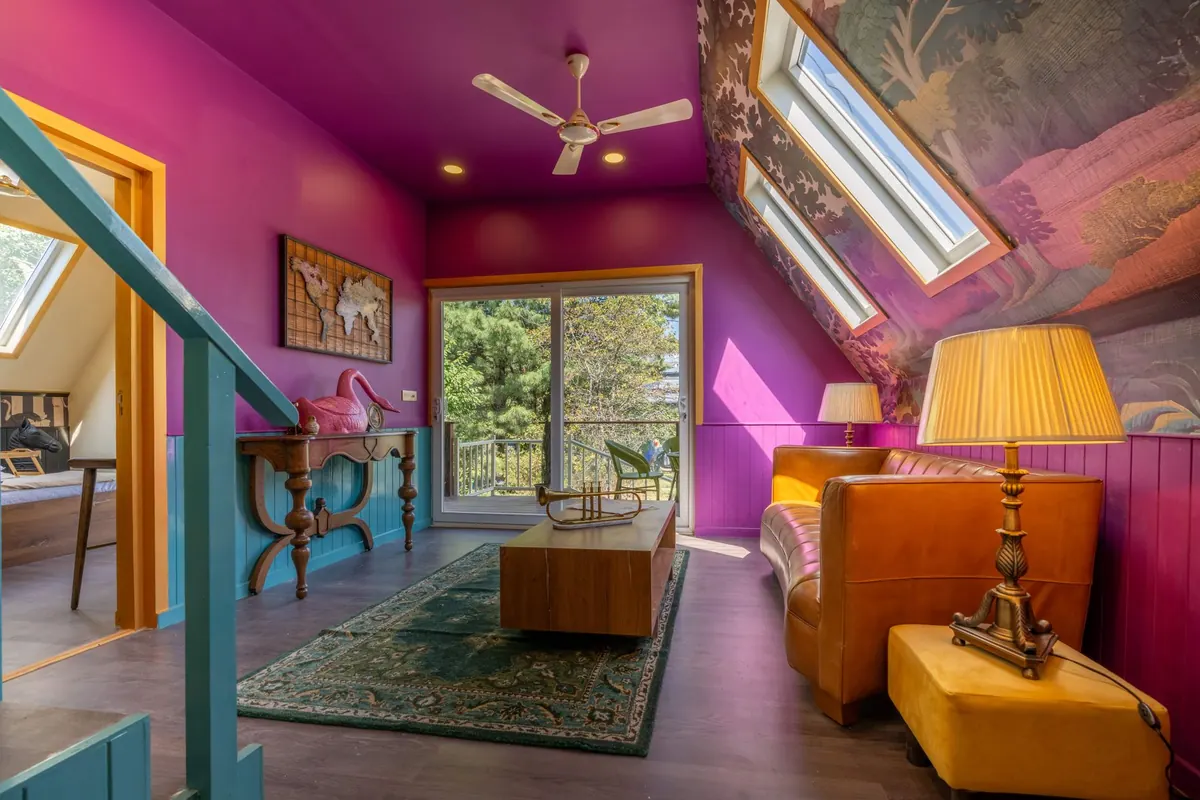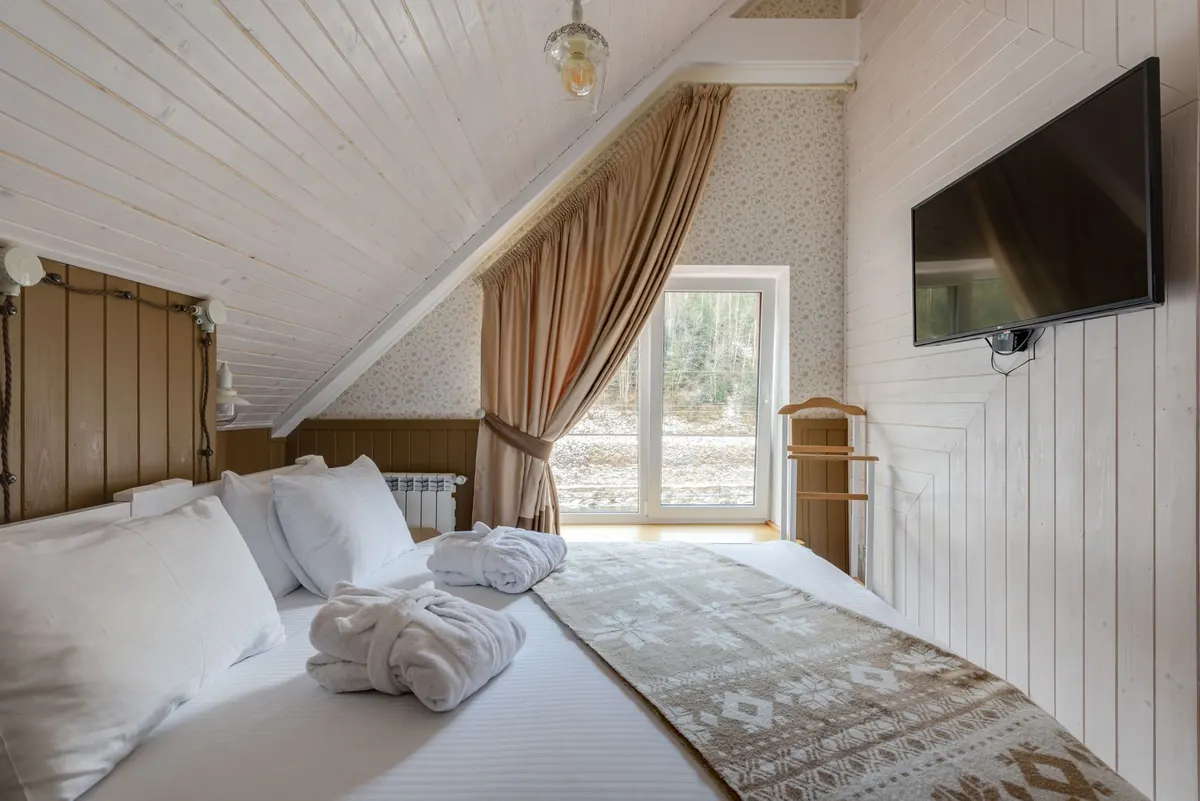
An attic asks different questions of a rug than a living room does. Downstairs, a rug mostly has to look right and feel good underfoot. Upstairs, under a sloped ceiling with a dormer window throwing light across one corner, it also has to solve problems: a strip of floor that reads as too narrow, a low wall that swallows pattern, a room that goes dim by four in the afternoon.
Moroccan, Turkish, and Persian rugs can all handle that job, but they behave very differently once they are on the floor. Knowing which tradition you are looking at — and why it looks the way it does — makes the choice much less mysterious, whether you are buying a new production rug online or hunting through a market with a measuring tape in your pocket.
Moroccan Rugs: Loose Lines and Undyed Wool
Moroccan rugs come out of a tribal, village-based weaving culture, and that shows in the details. Edges are not perfectly straight. A diamond lattice drifts slightly off centre. Lines wobble. This is not sloppiness; it is the signature of a weaver working from memory rather than a printed chart, and it is exactly why these rugs forgive awkward rooms.
The style most people recognise is the Beni Ourain rug: thick cream or ivory wool with a dark brown or black diamond grid, made for warmth in the Atlas Mountains. The pile is deep, which feels wonderful in a converted loft with a cold floor, but check door clearance before you commit. Related styles move in different directions. Azilal and Boujad rugs bring rust, pink, and saffron into abstract compositions; Boucherouite rugs are woven from recycled rags and come in bright, almost painterly patches.
For an attic, the appeal is twofold. First, the ivory field of a classic Beni Ourain lifts a low-ceilinged room that gets little direct sun. Second, the irregular geometry looks intentional against architecture that is already a bit odd. A perfectly symmetrical rug in a room with one sloped wall and a chimney breast can feel like a rebuke to the space.
Turkish Rugs: Geometry With a Frame
Turkish weaving splits roughly into two families: flatwoven kilims and piled rugs. Both are built around clear, repeatable geometry — stepped medallions, hooked edges, borders of small motifs that march around the rug with real discipline. Where a Moroccan rug drifts, a Turkish rug locks in.
Among piled rugs, Oushak (Uşak) rugs are the ones most often used in interiors today: large-scale medallions, softly muted palettes, generous wool. Prayer rugs carry a single arch-shaped niche at one end, a shape that gives a small room an instant focal point. City workshop rugs from centres such as Hereke are finer and denser, often with silk, and read as more formal.
One technical difference is worth knowing because it affects how a rug feels and wears. Turkish rugs are typically tied with a symmetrical (double) knot, which produces a firmer, more compact surface; Persian rugs usually use an asymmetrical (single) knot, which allows finer, more fluid drawing. Neither is better. The Turkish knot simply gives you a rug that stands up well to traffic and holds a graphic silhouette.
Persian Rugs: Curves, Borders, and Detail
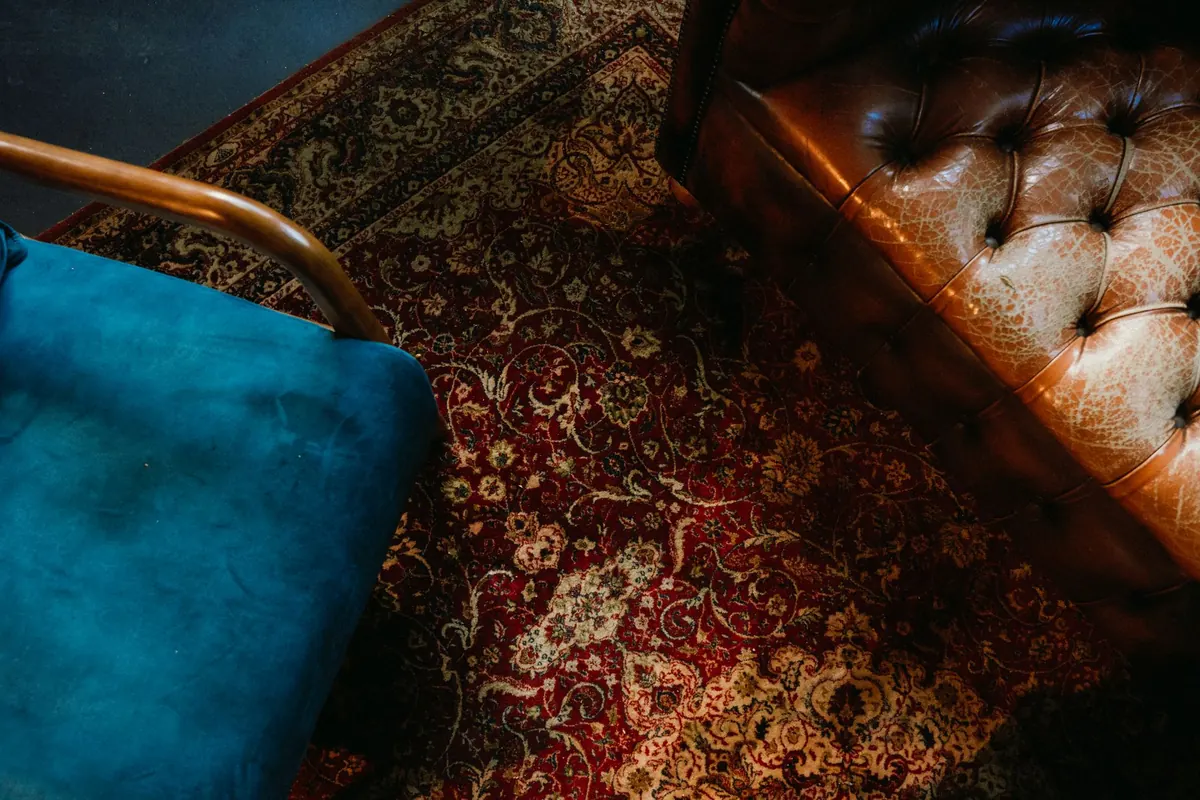
Persian rugs reward close looking. The classic city rugs — Tabriz, Kashan, Isfahan, Nain — are drawn with curving floral vines, a central medallion, corner spandrels, and several nested borders. The palette tends toward madder red, indigo, and ivory, and the knot density is high enough that a vine can taper to a hairline.
That detail is the catch in an attic. Fine curvilinear work disappears at three metres, and it disappears faster in a room with one small window. A Persian rug is happiest where you can actually see it: beside a bed you walk past daily, in the reading nook under the dormer, along the stretch of floor where you stand to dress. Tribal Persian rugs, such as Qashqai pieces, are coarser and more geometric, and they hold up better at a distance in a low-lit room.
Persian rugs also tend to run large. In an attic, a big rug can easily push under the eaves and lose half its border, so measure the flat floor area before you fall in love with a 3 × 4 metre piece.
The Three Styles Side by Side
- Moroccan: irregular lines, thick pile, undyed cream or bright rag colours; best for softening odd angles and warming cold floors.
- Turkish: strong geometric medallions, disciplined borders, muted or saturated wool palettes; best for graphic impact and heavy foot traffic.
- Persian: curvilinear florals, multiple borders, dense fine knotting; best where the rug can be seen up close and the room has decent light.
- Scale clue: Moroccan motifs are large and sparse, Turkish motifs are medium and repeated, Persian motifs are small and layered.
Fitting a Rug to Attic Proportions
Measure the floor, not the room
Attic square footage is misleading. What matters is the flat area where the ceiling is high enough to stand. Mark the usable rectangle on the floor with painter's tape, then lay down newspaper or kraft paper cut to the size of a rug you are considering. Walk around it for a day. You will immediately see whether it crowds the eaves storage or leaves an awkward sliver of bare floor.
As a rule of thumb, aim for roughly 30 to 45 cm of visible floor between the rug and the walls on the open sides. Under a bed, the rug should extend about 50 to 60 cm beyond each side so your feet land on wool rather than boards.
Match the shape to the architecture
Align a rectangular rug with the window wall rather than the slope. The eye reads the horizontal, and the sloped ceiling then feels like a deliberate canopy instead of a mistake. In tight corners, a round rug solves what a rectangle cannot. A long runner along a knee wall, or between two beds pushed under the eaves, is one of the most useful purchases you can make for an attic.
Reading Attic Light Before You Choose Colour
Attic light is directional and often stingy. A dormer window throws a bright wedge across the floor and leaves the rest in shade, and deep pile shows every footprint in raking light. Two practical moves help.
First, test a colour in the room at the hour you actually use it. A rug that looks chalky in a bright showroom can turn grey and heavy at seven in the evening under a single lamp. Second, use value rather than pattern to solve a dark room: an ivory, sand, or soft rust field will lift a north-facing attic in a way that a deep indigo rug, however beautiful, will not.
If you have skylights, remember that strong sun fades wool and shifts reds toward pink over years. Rotate the rug twice a year, and pull a blind across during the brightest hours of summer.
A Practical Checklist Before You Buy
- Measure the flat floor area twice, and carry those numbers with you — in centimetres and in feet.
- Check door swings, radiators, and eaves storage. A rug that blocks a cupboard door will annoy you within a week.
- Turn the rug over. A hand-knotted piece shows a clear, slightly uneven pattern on the back; a machine-made one looks like a printed grid.
- Look for abrash — subtle bands where hand-dyed wool shifted tone. It is a sign of handwork, not a defect.
- Check the fringe. On a hand-knotted rug it is the warp itself; a sewn-on fringe is a shortcut worth questioning.
- Ask how it was cleaned and whether it has been repaired. Rewoven patches are fine if priced accordingly.
- Buy a pad. It protects the knots, stops the rug creeping on floorboards, and makes a thin kilim feel considerably better underfoot.
- Confirm the return policy in writing before you pay, especially for online purchases.
Once it is home, vacuum wool rugs with suction only — no beater bar — and rotate them twice a year so the light and the wear spread evenly. A well-chosen Eastern rug will outlast the conversion itself, so take the extra afternoon to get the size and the value right. The pattern is the pleasure; the fit is what makes the room work.
Photo: Mathias Reding / Pexels