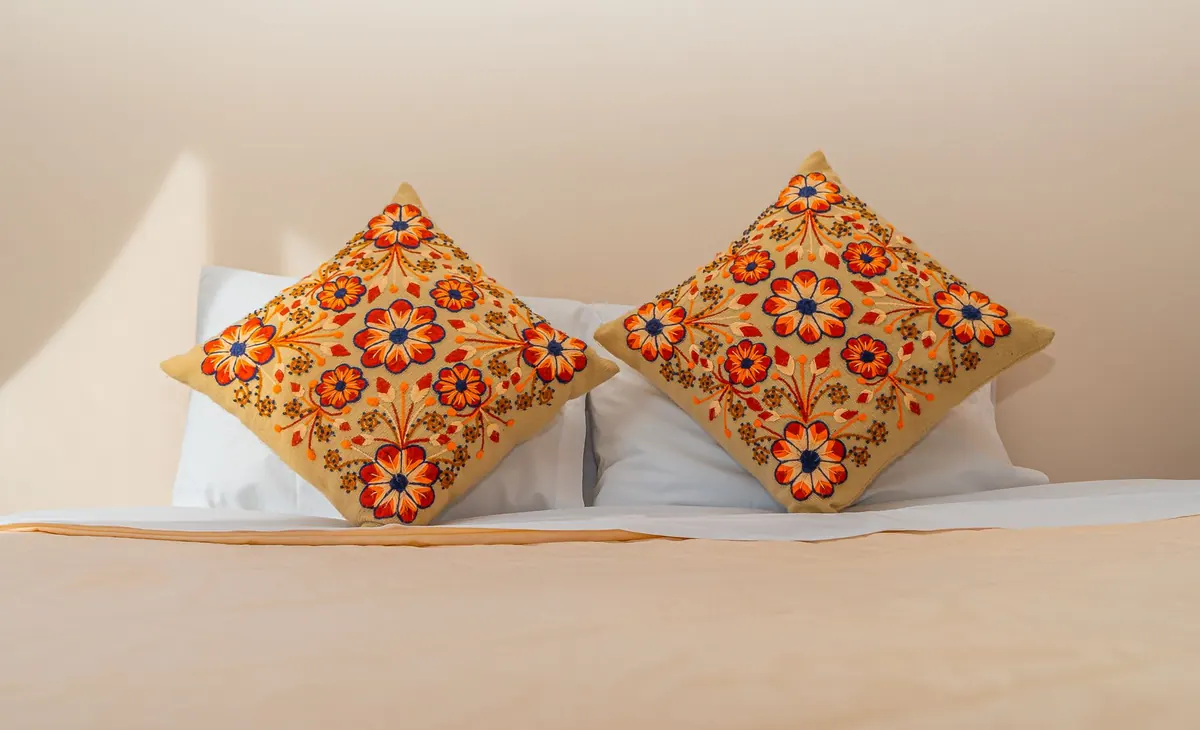
An attic bedroom has its own rules. The ceiling slopes, the windows sit low or high, and the walls sometimes tilt in ways that make a level headboard look like a small miracle. That architecture is an asset. Eastern textiles—flatweave kilims, embroidered suzani panels, woven wool and cotton—bring warmth and colour to these odd corners, but only if you edit them. The goal is not a souk in the eaves. It is a calm room with two or three textiles that earn their place.
Read the Attic Before You Buy a Textile
Start with the room, not the shopping basket. Attic bedrooms tend to have less usable wall space than they appear to have, and the floor plan is often interrupted by a chimney breast, a low knee wall, or a door that swings into the only clear corner. A beautiful kilim will not fix a bad fit. Measure the flat floor area first, then mark the likely rug size with painter’s tape. Leave a border of bare floor around the edges. A rug that stops just short of the walls makes a small attic feel tighter; a rug with a little breathing room makes it feel considered.
Light, height, and sightlines
Roof windows and skylights are wonderful for daylight, but they can be hard on textiles. Strong sun will fade wool, cotton, and silk over time, especially in a room that heats up under the roof. If a suzani or kilim sits in direct sun, rotate it, add a lining, or use a simple blind at the brightest hours. Low ceilings also change where pattern belongs. Keep the busiest textiles low—on the floor, at the foot of the bed, on a bench—rather than hanging them across a slope where they crowd the headspace. A flat gable wall is usually the best place for a hanging panel.
Choose One Hero Pattern
Kilims and suzani do different jobs. Kilims are usually geometric, grid-like, and easy to live with on the floor. Suzani is embroidered and often large-scale, with circular medallions, vines, and pomegranate motifs that draw the eye immediately. Put both in the same attic bedroom and you risk a visual argument. Pick one to lead. If the suzani is the hero, let the kilim be quiet—a narrow runner, a small bedside rug, or a cushion in a restrained palette. If the kilim is the hero, keep the bed plain and use suzani only as a single cushion or a folded throw.
Colour is the simplest way to keep the peace. Choose two or three colours from the main textile and repeat them elsewhere: a faded red in the suzani picked up by a wool blanket, a deep indigo from a kilim repeated in a lampshade or a ceramic vase. You do not need to match patterns. Matching one strong colour or one level of warmth is enough. When in doubt, choose the textile with fewer colours and let texture do the rest.
Put Kilims to Work on the Floor
A kilim is a natural foundation for an attic bedroom because it is flat, hard-wearing, and less bulky than a deep pile carpet. Use one larger kilim under the lower two-thirds of the bed, or a runner along the side where you step out. In a narrow room, a runner can be more useful than a full-size rug: it warms the cold patch by the bed without swallowing the floor. Add a good rug pad underneath. It keeps the kilim from sliding on floorboards and makes the weave feel softer underfoot.
Keep the composition simple. One kilim with a clear field colour is easier to live with than three small rugs scattered around the room; small rugs chop up the floor and make the space feel restless. If the kilim has a busy border, let the middle of the room stay plain. If the bed linen is patterned, choose a kilim with a quieter ground. A flatweave with worn colours and a simple stripe can be just as expressive as a complex medallion pattern, and it will not fight a suzani cushion across the room.
Let Suzani Be the Event
Suzani works best when it is allowed to be the main event. Use a suzani coverlet on the bed, a panel hanging above the headboard, or a large throw folded at the foot of the bed—not all three at once. A single suzani on a plain linen bed is a strong, warm gesture. Two suzani cushions on top of that may be one too many, especially under a sloped ceiling where the eye is already dealing with angles.
If you hang a suzani, treat it properly. Line it with a soft cotton fabric, hang it from a rod or a narrow batten rather than pinning it directly to the wall, and keep it out of direct sun. A suzani with large medallions needs empty wall around it; do not crowd it with small frames or shelves. If the only available wall is low or angled, use the suzani on the bed instead. The pattern will still be visible, and the room will feel calmer for it.
Build a Quiet Base of Woven Textures
Texture is the secret to making Eastern textiles feel at home without turning the room into a pattern showroom. Start with a calm base: washed linen sheets, a cotton quilt, a wool blanket in oatmeal or grey, a jute or sisal floor covering if the kilim is small. These woven surfaces add depth without adding motif. The eye reads them as softness, not noise.
Then add one or two Eastern textures that support the hero. A block-printed cotton cushion, a woven wool bench, a kilim-covered stool, or a simple woven lampshade can carry the mood without competing. Keep the base colours close to each other—chalk, mushroom, sand, faded indigo—and let the hero textile supply the contrast. Avoid placing shiny synthetics next to handwoven wool and cotton; the difference in surface can make the natural fibres look flat. A little roughness is part of the charm.
Edit With Negative Space and Repetition
Busy rooms are rarely caused by one bold textile. They are caused by too many good things with no pauses between them. In an attic bedroom, where the architecture already supplies slope, angle, and awkward corner, restraint matters more than ever. Use these rules as a final edit:
- One large pattern per sightline. From the bed, you might see the suzani throw and a plain wall. That is enough. Do not add a patterned kilim, a patterned headboard, and a patterned curtain to the same view.
- Leave a plain border. Around a hanging suzani, beside a kilim runner, and between cushions, bare space gives the pattern somewhere to sit.
- Repeat one colour three times. A red from the suzani can appear in a blanket, a small ceramic, and a book spine. Repetition makes eclecticism look intentional.
- Choose one small accent. A single suzani cushion, a woven basket, or a kilim-covered bench is usually enough. Two small accents can work if they are in the same family.
- Keep the floor edges clear. Let the kilim stop before the wall. Let the bed breathe. Let the room keep some empty floor.
A Slow Layer for the Attic Bedroom
Build the room in stages rather than buying everything at once. Clear the space and measure the flat floor and walls. Choose the hero textile first—one suzani or one kilim—and live with it for a week before adding anything else. Then bring in the quiet base: plain bedding, a wool blanket, a simple rug pad, a woven shade. Add one small accent only when you notice a spot that feels bare. This slow approach keeps the attic from becoming crowded and gives you time to see how the light changes through the day.
Care matters, too. Vacuum kilims gently with a brush attachment, shake them outside when the weather is dry, and rotate them now and then so wear is even. Keep textiles away from damp corners and fix any condensation or roof leak before you lay down a rug. For valuable or antique pieces, ask a textile conservator before washing or repairing. In a well-ventilated attic, with one strong pattern and a calm woven base, Eastern textiles can make a sloped, awkward room feel like the warmest place in the house.